
How sure is it that oak wilt is in Bell County?
As sure as the state's own records get. The Forest Service's county maps name only counties with more than twenty oak wilt mortality centers on its books, and Bell is one of them, along with its neighbors Coryell, Lampasas, Williamson and McLennan, plus Travis farther south. The maps mark spots where trees died in a pattern consistent with oak wilt and draw a 0.75-mile buffer around each; the Forest Service presents them as a general reference rather than a survey of every yard (TexasOakWilt.org, checked Nov 15, 2026).
Statewide, oak wilt has been documented in 76 Texas counties, according to both the Texas A&M Forest Service (AgriLife Today, Feb 7, 2024) and the U.S. Forest Service's 2025 forest health report for Texas, which adds that most of those counties are west of I-35 (both checked Nov 15, 2026). Harker Heights and Killeen sit on the west side of the interstate.
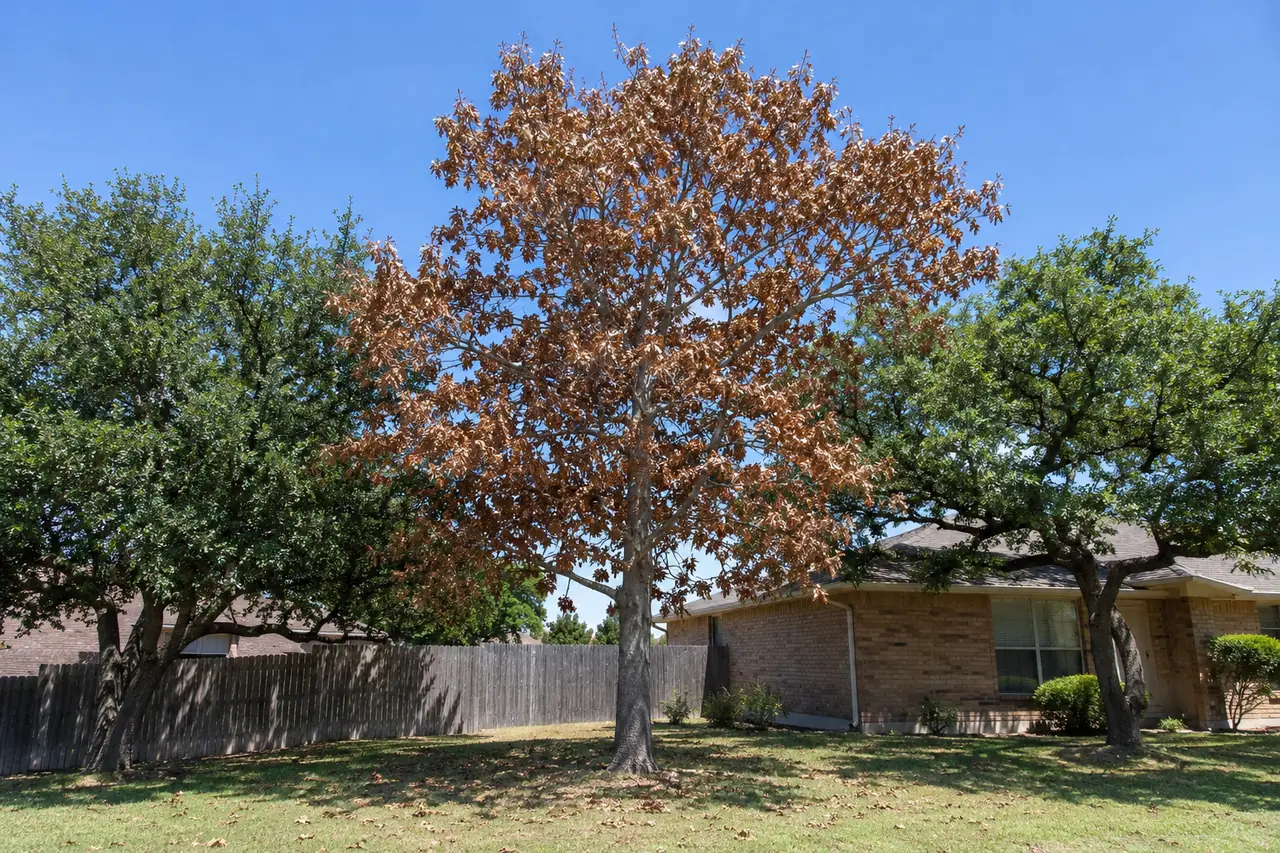
How does oak wilt get from one tree to the next?
Two routes, according to the Forest Service (AgriLife Today, Feb 7, 2024, checked Nov 15, 2026):
- Through the roots. Oaks growing near each other can join roots underground, and the disease moves through those connections. All oaks can pass it this way, and live oaks are the ones the agency singles out.
- By beetles. Sap-feeding beetles carry it above ground, to fresh wounds on healthy oaks. Red oaks are the trees that start new disease centers.
That's why one sick live oak on a street of live oaks worries people, and why the pruning calendar matters so much: a fresh cut in spring is the kind of opening those beetles find.
How do the symptoms differ between live oaks and red oaks?
The Texas Forest Service guide "Identify and Manage Oak Wilt" (updated 2008) describes different symptoms in each group (checked Nov 15, 2026).
| Live oak | Red oaks (Shumard red oak and its kin) | |
|---|---|---|
| The leaves | Veinal necrosis: the leaf veins turn yellow, then brown | The crown takes on bright, autumn-like color in summer |
| Other clues | The vein pattern is the main live oak sign the guide gives | Fungal mats under the bark, which the guide calls reliable indicators for diagnosing oak wilt |
| Why it matters | Spreads to nearby oaks through shared roots | Starts new disease centers |
Not every brown oak has oak wilt. The U.S. Forest Service's 2025 report for Texas says drought caused widespread decline and death across several species that year (checked Nov 15, 2026), and a drought-stressed tree can look rough without carrying any disease. A tree crew can tell you what they see; the fungal mats on a red oak are the clearest sign the guide names.
When is it safe to prune or cut an oak?
To slow oak wilt, the Forest Service says oaks shouldn't be pruned or otherwise wounded in the February-to-June stretch, and every pruning wound should get paint (AgriLife Today, Feb 7, 2024). The 2008 guide adds that wounds and fresh stumps should be painted regardless of season. The trimming page sets that out as a calendar, including what to do when a storm breaks a limb in April.
What does taking out an infected oak involve?
The removal itself is ordinary tree work. A few steps matter more than usual:
- Paint the stump the day it's cut. The Texas Forest Service guide says fresh stumps get painted in any season, just like pruning wounds.
- Protect the oaks that remain. Between February and June, any scrape a truck, loader or falling limb leaves on a nearby oak is a fresh wound. Ask how the crew will rig the tree and bring equipment in without hitting its neighbors.
- Plan for the wood. The crew has to haul it: Harker Heights' brush drop site on FM 2410 bars tree trimming companies, and the city's hauler doesn't take curbside brush piles (harkerheights.gov brush page, read Nov 15, 2026). Burning it inside city limits needs a Fire Marshal's permit.
- Check whether a permit applies. As of Nov 15, 2026, Harker Heights' tree chapter (Code Ch. 102) sets no removal permit for private trees on home lots. In Belton, the 2016 Design Standards (read Nov 15, 2026) say the heritage-tree mitigation requirements don't apply once the city confirms a tree is dead, dying or fatally diseased.
Texas Local Government Code § 212.905(h) normally keeps cities from banning or charging for the removal of a diseased tree. Its subsection (i), though, takes the whole section away from property inside five miles of a military base that was in active use on Dec. 1, 2017, and Harker Heights borders Fort Hood (enrolled H.B. 7; 2016 Fort Hood Joint Land Use Study; both read Nov 15, 2026). The rules page explains what that does and doesn't change. For what a removal costs, see tree service pricing. If an oak on your lot looks wrong, call (254) 613-7717 or send a request and one independent contractor serving Bell County will come look at it.
Is emerald ash borer a second threat here?
Yes. On July 15, 2025, the Texas A&M Forest Service announced that the beetle had been confirmed in five more counties, Bell among them, and said Bell County's confirmation made it "the southernmost confirmed location of EAB in the nation." By then it had spread to 31 Texas counties. The U.S. Forest Service's 2025 report for Texas lists the Bell County confirmation too. Neither the Forest Service release nor the federal report says where in the county it was found (both read Nov 15, 2026).
Ash trees are what it kills. The Forest Service's list of signs:
- dead branches near the top of the tree
- bark splits that expose S-shaped tunnels underneath
- heavy woodpecker activity
- D-shaped exit holes in the bark
- leafy shoots sprouting from the trunk
Early infestations may show few or none of these. The adults fly especially in May and June in Texas. Don't move firewood; burn it where you bought it. Report a suspect tree to the EAB hotline at 1-866-322-4512.
Oak wilt questions from Harker Heights
My red oak browned during a dry summer. Is that oak wilt?
Possibly, but drought alone killed and weakened many Texas trees in 2025, per the U.S. Forest Service. The autumn-colored crown in summer and fungal mats under the bark are the red oak signs the Texas Forest Service guide describes. Have the tree looked at before deciding.
Does the February-to-June rule cover cedar or cedar elm?
The advice is written for oaks, because oak wilt is an oak disease. But if cedar clearing or elm work will put saws and machines near your oaks in those months, the oaks can still be wounded, so ask how the crew plans to avoid that.
Is there a permit to take down a diseased oak in Harker Heights?
Not for a private tree on your own home lot: as of Nov 15, 2026, Chapter 102 requires written permission only for public trees on city property, parks, streets and rights-of-way. The same chapter, in § 102.02(C), lets the city treat, prune or remove a private tree that harbors insects or disease threatening other trees, and recover the cost through a lien on the property (Harker Heights Code, checked Nov 15, 2026). A diseased oak is better handled by the owner first.
What should I do with the wood from an ash tree?
Keep it on the property. The Forest Service's advice for emerald ash borer is not to move firewood and to burn it where you got it.