
When does a stump grinder need an 811 ticket?
Texas Utilities Code § 251.002(5) defines excavating to include using "a motor, engine, hydraulic or pneumatically powered tool, or other mechanized equipment of any kind" to move or disturb soil 16 inches deep or more. A stump grinder is mechanized equipment, so a grind that goes that deep fits the definition. Section 251.151(a) then sets the timing: the notification center's window opens 14 days before the digging and closes 48 hours before it, and Saturdays, Sundays and legal holidays don't count toward those hours (both checked Nov 15, 2026).
A few practical points:
- Count business days. Texas811's homeowner page says to contact 811 two business days before digging, and lists planting a tree among its examples (texas811.org, checked Nov 15, 2026). A Friday afternoon call doesn't clear a Monday morning grind.
- No homeowner exemption. The law's exemptions in § 251.003 (read Nov 15, 2026) cover things like storage tanks, secured facilities, well bores, oil and gas field lines and cemeteries, not homeowners. They also cover lines that serve only the owner and run entirely on the owner's property, so point out anything private you know about, like a line to a shop or an irrigation system.
- Ask who files. The duty sits with the person who intends to excavate. If the contractor is filing, ask for the ticket number and wait for the marks before work starts.
What's under a stump in Harker Heights?
Bell County is split by the Balcones Escarpment, which runs southeast to northwest through roughly the middle of the county, according to the Handbook of Texas (revised Sept. 30, 2026, checked Nov 15, 2026):
| West of the escarpment (Grand Prairie) | East of it (Blackland Prairie) | |
|---|---|---|
| Lay of the land | Rolling uplands cut by stream valleys, some stony slopes and steep bluffs | Mostly level to gently rolling |
| Soils | Light to dark loamy and clayey soils with limy subsoils, and shallow, stony soils in places | Dark "blackland" clays, Houston Black clay the most common |
Harker Heights, Killeen and Nolanville are on the county's western side. Houston Black clay, the Texas state soil, is the eastern story: the Texas Water Development Board describes it as a highly expansive clay that shrinks and swells sharply as moisture changes (twdb.texas.gov, checked Nov 15, 2026).
What that means for a grinder on a particular lot is something to settle in person. Bell County's soil survey maps soil types across the county, and this site hasn't checked it for your street. Ask the contractor whether the stump looks like it sits on rock, how deep they plan to grind, and whether the price changes if the grinder hits stone.
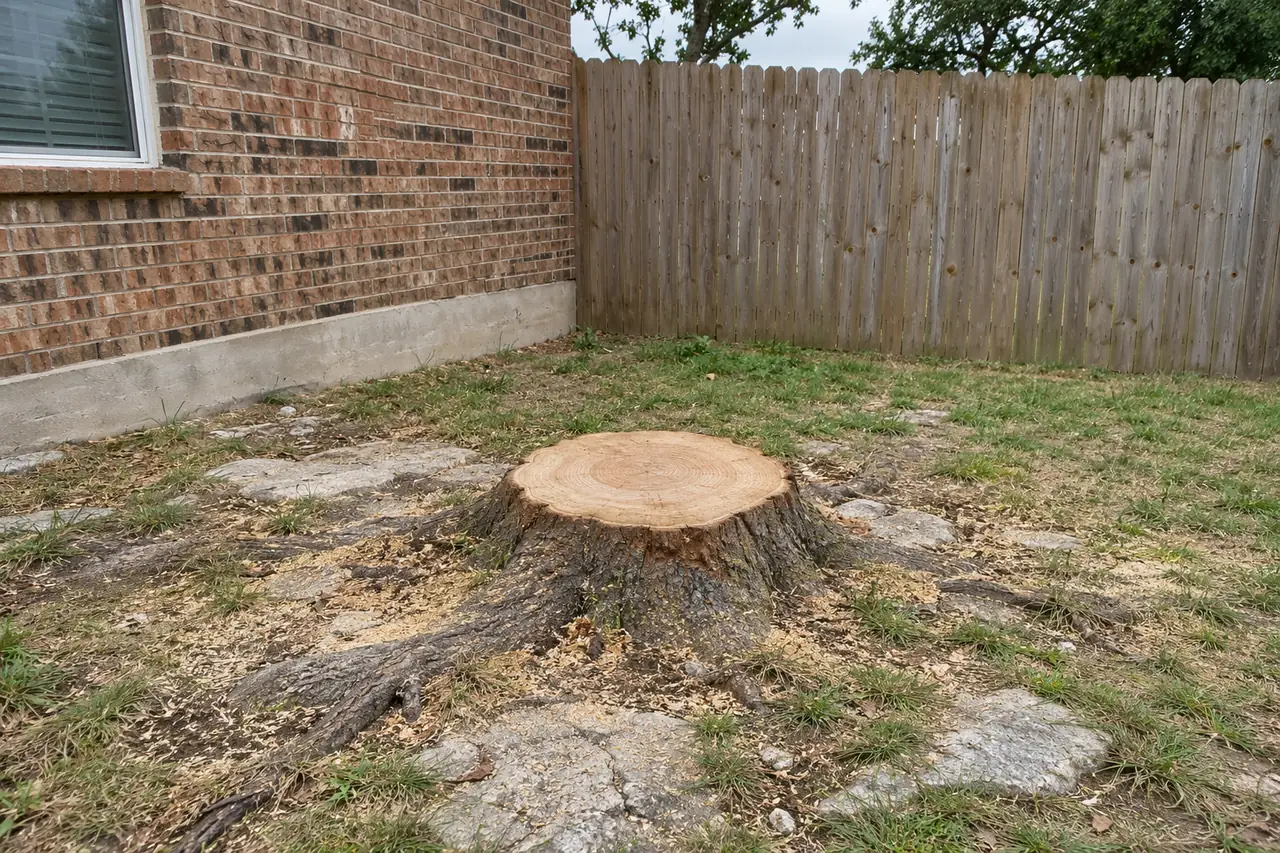
What's left after a stump is ground?
A pile of grindings, wood chips mixed with soil, and a shallow hollow where the stump was. Settle these before the crew leaves:
- The grindings. Left to fill the hole, spread as mulch, or hauled. If hauled, it's a line on the price; HomeGuide's haul-away figure is $75 to $250 each time a load goes to the dump (checked Nov 15, 2026). Harker Heights' drop site on FM 2410 doesn't take loads from tree companies (harkerheights.gov brush page, read Nov 15, 2026).
- Surface roots. A grinder works the stump and its root flare. Roots running farther out are a separate job, priced by HomeGuide at $75 to $150 an hour.
- The hollow. Whether the crew fills it, or you plan to add soil and seed later.
Does an oak stump need special handling?
Yes, at the moment it's cut. The Texas Forest Service's oak wilt guide says fresh stumps should be painted, along with every pruning wound, regardless of season (checked Nov 15, 2026). Bell County is on the Forest Service's oak wilt county map, so that's worth insisting on when an oak comes down.
Grinding later is a second consideration. All oaks can share oak wilt through grafted roots, live oaks especially (AgriLife Today, Feb 7, 2024). If healthy live oaks stand close to the stump, ask how the grinder will stay clear of their trunks and roots, especially between February and June, the months the Forest Service says to avoid wounding oaks. More on the oak wilt page.
What does stump grinding cost?
- Angi: $100 to $150 for the first stump, then about $50 for each additional one.
- HomeAdvisor: $100 to $400 for grinding; $200 to $550 for full stump and root removal (page updated April 16, 2024).
- HomeGuide: first stump $120 to $400, every stump after it $30 to $60; or $2 to $6 per inch of diameter, or $100 to $200 an hour; minimum charge $80 to $160; extra-large stumps $300 to $800.
All checked Nov 15, 2026. If the stump comes from a tree being removed now, ask for the grinding to be listed on the same written price; the pricing page has the removal side. For a stump in Harker Heights or nearby, call (254) 613-7717 or send a request to reach one independent contractor who grinds stumps in the area.
Is the stump yours to grind?
Usually, if it's on your lot. Harker Heights' Chapter 102 defines public trees as those on city property, parks, streets and rights-of-way, and § 102.03 makes it an offense to injure or remove one without the city's written permission (Code Ch. 102, read Nov 15, 2026). A stump in a city right-of-way is a question for Parks and Recreation at 254-953-5657 before anyone grinds it. In Belton, a heritage tree needs its removal permit before it ever becomes a stump; the rules page lists the sizes.
Stump questions
Does the 811 rule apply to a rented grinder too?
Yes. The 811 law has no homeowner exemption, so a rented grinder going 16 inches deep or more needs the same notice and the same wait.
Who calls 811, the homeowner or the contractor?
The law puts it on whoever is going to excavate. If the contractor is the one filing, ask for the ticket number before the work date.
Can a stump be left alone?
Yes. Grinding is a choice, not a requirement. A stump cut close to the ground can stay where it is.
What if the crew hits rock?
That's the conversation to have before work starts, not after. Ask how deep they'll grind and whether stone changes the plan or the price.