
Why do trees around Harker Heights end up coming down?
Some reasons are obvious from the street: a tree that died, a trunk that split in a storm, a limb resting on the roof. Others are particular to this county, and they're worth knowing before you decide whether a tree can stay.
- Drought and hard winters. The U.S. Forest Service's 2025 forest health report for Texas says drought caused widespread decline and death across several tree species, and that damage from a February cold snap was significant. The same report lists hypoxylon canker among the state's lesser tree diseases (USDA Forest Service, checked Nov 15, 2026).
- Oak wilt. Bell County is on the Texas A&M Forest Service's oak wilt county map, which lists only counties with more than twenty recorded mortality centers (TexasOakWilt.org, checked Nov 15, 2026). The oak wilt page covers the signs on live oaks and red oaks.
- Emerald ash borer. Confirmed in Bell County in July 2025, which made the county the southernmost confirmed location of the beetle in the nation; it had reached 31 Texas counties by then (Texas A&M Forest Service, July 15, 2025, checked Nov 15, 2026). An ash with a dying top, splitting bark or a lot of woodpecker damage deserves a look.
- Storm breakage. When the April 12, 2022 EF3 tornado crossed southern Bell County, the National Weather Service's survey found many hardwood trees uprooted or snapped along the FM 2843 corridor, and many power poles snapped (NWS Fort Worth, checked Nov 15, 2026). See storm and hail damage.
Does Harker Heights require a permit to remove a tree?
Not for a tree on your own home lot. Chapter 102 of the city code, adopted as Ordinance 2011-21 on Aug. 9, 2011, sorts trees into two groups. Public trees are those "on city property, including all city parks, streets and rights-of-way"; private trees are every other tree in the city. Section 102.03 makes it unlawful to injure, remove or destroy a public tree, or to plant one, without written permission from the City Manager or the Parks and Recreation Director. The chapter sets no matching permit for private trees (Chapter 102 on eCode360, read Nov 15, 2026).
Two cautions come with that. First, a tree in the right-of-way along the street is a public tree even when it looks like part of your front yard, so if you aren't sure where your lot ends, ask Parks and Recreation at 254-953-5657 before anyone cuts. Second, under § 102.02(C) the city may treat, prune or remove a private tree that harbors insects or disease threatening other trees, or that is a serious danger to people or property, and recover the cost through a lien on the property. A dying or dangerous tree on your lot is yours to deal with, one way or the other.
The zoning code's landscaping section (§ 155.051) asks for a landscape plan that shows every existing tree on a site being developed. That's paperwork for development plans, not a removal permit for a house that's already built (Zoneomics copy of the Harker Heights zoning code, read Nov 15, 2026). An HOA or deed restriction can still say something about trees, so read yours if you have one.
Belton is different. On a developed residential lot there, removing a designated Belton Heritage Tree takes a city permit, and the size list starts at 21 inches across for a Shumard red oak. The tree rules page has Belton's full list.
Does the state's tree-fee law cover a Harker Heights home?
Possibly not, and that's unusual in Texas. Local Government Code § 212.905 keeps cities from charging a tree mitigation fee on small trees at a home you live in, and from forbidding or charging for the removal of a dead, diseased or imminently dangerous tree. But its subsection (i) says the section doesn't reach property "within five miles of a federal military base" that the military was actively using on Dec. 1, 2017 (enrolled H.B. 7, read Nov 15, 2026).
Harker Heights borders Fort Hood: the Army's 2016 Joint Land Use Study lists it with Killeen as the cities on the post's south side (oldcc.mil, read Nov 15, 2026). So the state limits don't apply to property within five miles of Fort Hood, which takes in at least the parts of Harker Heights, Killeen, Nolanville and Belton nearest the post. Whether your own lot is inside the five miles takes a measurement from the boundary; this site hasn't measured any. Since Harker Heights' code (Ch. 102, checked Nov 15, 2026) sets no removal permit for private home lots, the practical effect inside the city is small for now.
What if the tree is close to an Oncor line?
Oncor owns the wires in Harker Heights; the city posts Oncor's "Make Ready" tree program on its own website. Oncor's tree pruning page lays out who does what (checked Nov 15, 2026):
- Pole-to-pole lines. If a tree is within 10 feet of one, call Oncor at 888-313-6862 and ask for a Make Ready prune before the removal. Oncor's crews prune the tree back from the line and leave all the trimmings and debris for the property owner.
- Who may work near them. Oncor's flyer is direct: "Only Oncor and its VM Contractors can prune in close proximity to high voltage lines." Its general guidance is that no part of a tree should be within 10 feet of a distribution line.
- The line to your house. Make Ready isn't available for pole-to-house lines, per Oncor's Make Ready flyer (read Nov 15, 2026). For that wire, Oncor's FAQ says to hire a private arborist, and it notes there are charges for disconnecting and reconnecting service.
- A tree that has already fallen. "If a tree falls, it is the resident's responsibility to remove it," the FAQ says.
Outside Harker Heights, some parts of Bell County are served by electric co-ops: Heart of Texas Electric Cooperative and Bartlett Electric Cooperative both list Bell among their counties (checked Nov 15, 2026). If you're not sure who owns the line over your yard, your electric bill or provider can tell you, and the contractor needs to know before the work date.
Where do the logs and brush go once the tree is down?
This is where Harker Heights differs from a lot of Texas towns. Waste Management, the city's hauler, doesn't take brush piles set at the curb. The city's Brush and Bulky Item Drop Site at 1761 FM 2410 is open Tuesday, Thursday, Friday and Saturday from 8 a.m. to 5 p.m. (last load 4:40 p.m.), and it's for residents' own loads: up to 4 cubic yards a load, two loads per household a day, with a current water bill and the identification the city's page lists. Overloaded pickups and trailers are refused, dump trucks are prohibited, and tree trimming companies can't use it at all (harkerheights.gov brush page, read Nov 15, 2026).
In practice, then, the crew that cuts the tree hauls the wood and brush away, and that should be a line in the written price. National guides put haul-away at about $70 (Angi), $50 to $100 (HomeAdvisor) or $75 to $250 for each dump run (HomeGuide), all checked Nov 15, 2026.
Other options:
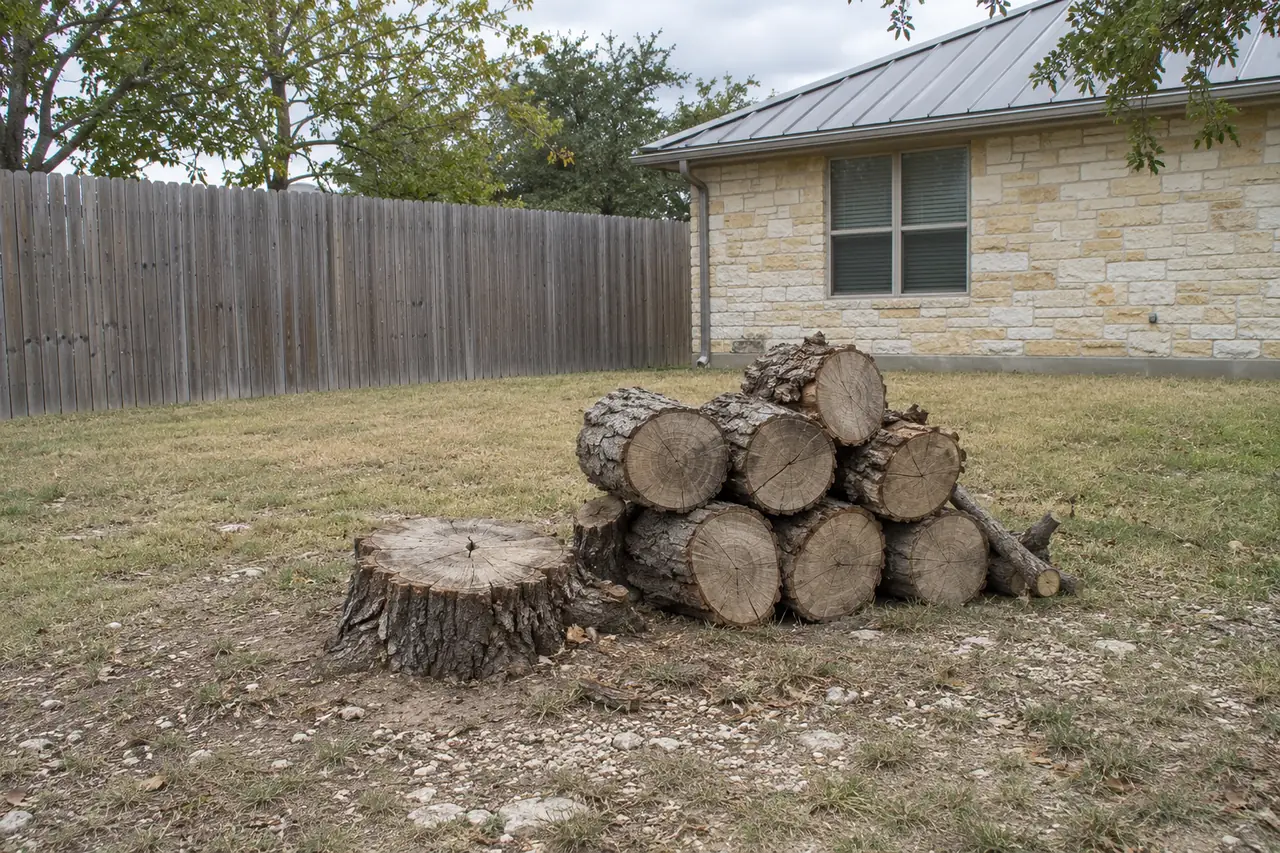
- Keeping firewood. Have the crew buck the trunk into firewood-length rounds and stack them. If the tree is an ash, keep the wood where it is: the Forest Service's advice for emerald ash borer is not to move firewood and to burn it where you got it.
- Burning on the property. Inside the city limits, open burning needs a Fire Marshal's permit, and burning without one can bring a fine of up to $2,000 (city burning flyer, checked Nov 15, 2026). Only the landowner can apply.
- Chips. If the crew chips the brush, say whether you want the chips left for mulch or hauled away. Angi puts chipping at about $95 on average (checked Nov 15, 2026).
Does the stump need an 811 call?
A grind 16 inches deep or more does. Texas law counts powered machines that churn soil 16 inches down or more as excavation, and 811 must be told two business days or more before the work (Texas Utilities Code §§ 251.002 and 251.151, checked Nov 15, 2026). What the county's stony ground means for a grinder is on the stump grinding page.
Whose insurance pays when a tree lands on a house?
Usually your own, if the tree hit the house. Many homeowners policies cover what a falling tree breaks, the Texas Department of Insurance says, and many give some coverage for removing trees or limbs that a storm brought down, but trees and limbs that come down in the yard without hitting anything usually aren't covered. A neighbor's tree is generally treated as an act of nature, so their policy probably won't pay unless they were at fault (TDI, Jan 24, 2026 and Feb 2023, checked Nov 15, 2026). Under Texas case law described in the State Bar of Texas Disaster Manual, a neighbor can be liable when the tree was already dead or decayed before it fell (TexasLawHelp.org, reviewed July 31, 2025, checked Nov 15, 2026).
What does taking a tree down cost here?
Angi and HomeAdvisor put the national average at $750 a tree, HomeGuide at $1,150, and HomeGuide's Austin range, the closest city any of them prices, is $330 to $2,250 per tree (checked Nov 15, 2026). Height, what the tree leans over, crane time and hauling move the number most. The pricing page breaks those down. For a price on your own tree, call (254) 613-7717 or send a request; it goes to one independent contractor serving Harker Heights, who looks at the tree and prices the job.
Removal questions from Bell County homeowners
Can I take down a dead oak in the spring?
The Forest Service's February-through-June caution is about wounding oaks, since fresh wounds draw the sap beetles that carry oak wilt, and its oak wilt guide says fresh oak stumps should be painted in any season. If live oaks stand near the dead one, ask the crew how they'll keep from scraping their bark or roots, and make sure the stump gets painted the day it's cut.
What if the tree hangs over the fence from my neighbor's yard?
The State Bar's Disaster Manual says you may trim the branches of a healthy neighbor tree that reach over your line, on your side only; you can't make the neighbor do it, and if your trimming kills the tree, the neighbor may seek damages. If you think the tree is dangerous, say so to the neighbor in a letter and hold on to a copy.
Is a tree in the strip by the street mine to remove?
Maybe not. Chapter 102 counts trees on streets and rights-of-way as public trees, and § 102.03 makes removing or injuring one without written permission an offense. Call Parks and Recreation at 254-953-5657 before cutting one.
Can the contractor leave the wood for me to deal with later?
Yes, if that's what the contract says. Just remember the city won't pick up curbside brush piles, and the drop site takes only what residents bring themselves, within the load limits above.